New in the app

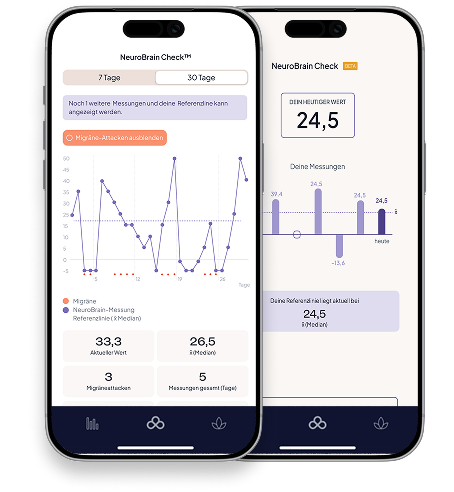
With the NeuroBrain Check you can test how migraine-sensitive your brain is.

Discover how your brain responds to stimuli, and spot patterns connected to your migraine.

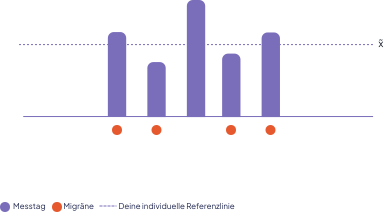
What does this graph show?

Your measurements over time, compared to your personal reference line.

Free to try. The NeuroBrain Check is part of the headacy app.

What is the NeuroBrain Check?

To test how migraine-sensitive your brain currently is, studies and specialists rely on the afterimage test – the very method the NeuroBrain Check uses.

What is an afterimage?

An afterimage is a visual effect that appears after looking at a high-contrast image. With the NeuroBrain Check you measure how long and how intensely you perceive this afterimage.

  • About 1–2 minutes

    Three short rounds, right in the app.

  • Individual reference

    Your personal reference line settles in automatically over the course of weeks.

  • Understand your patterns

    Learn to make sense of your patterns and your sensitivity.

A voice on the NeuroBrain Check

„I think that with the new Brain Check feature you've created by far the biggest collective guessing game in migraine history. Almost everyone is on the edge of their seat about what their own values mean. If this even remotely works, it would genuinely be a revolution! Thanks for the innovation!“

The focus is on the coming weeks and months

One step at a time: your individual reference line only forms slowly. Single values still say very little. Patterns emerge over weeks and months – and spotting them takes regular measurements. It's a bit like brushing your teeth: what counts here too is consistency.

Early changes

Some people already show changed values before an attack.

Individual spikes are normal

With only a few data points, no pattern can be recognised yet.

Patterns take time

Patterns only get interesting over weeks. The more regularly you measure, the clearer they become.

The more regularly and often you run the check, the more reliable the results become. Once a day, ideally under the same conditions (room, light, time of day). Remember: keep logging your migraine attacks as well.
Download the app for free now

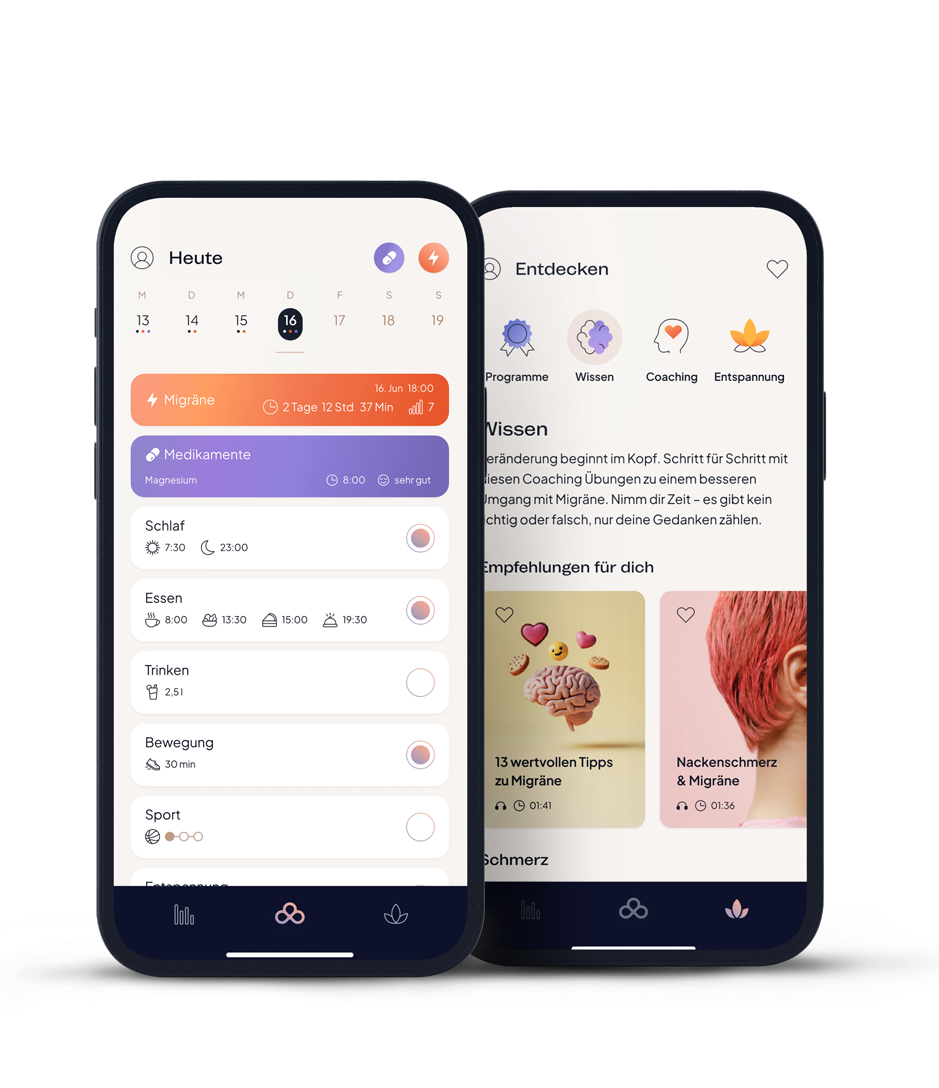
  • Build routines and habits
  • Calendar and diary function
  • Keep an eye on your triggers
  • Analyse connections
  • Developed by neurologists & patients

Free to try. The NeuroBrain Check is part of the headacy app.
Questions about the NeuroBrain Check

What does it mean if you already see the afterimage during the 30-second gaze at the black cross and feel slightly dizzy while doing so? Could that be a warning sign of the next migraine attack?
How you react during the test has nothing to do with whether an attack is coming. It's more likely that if you're currently very sensitive to stimuli, you feel the contrast/the bright display more strongly – and that can also feel unpleasant. Dizziness or nausea can occur as a reaction during the test. If it gets too unpleasant for you: stop the test. Also: whether you see the afterimage already during the cross doesn't matter. What matters is what's visible as an afterimage after the cross.
Can nausea or migraine headaches occur during the test?
Yes, headaches and nausea can occur. The test can intensify the onset of an attack – but it doesn't by itself trigger an attack that wasn't going to happen anyway. If you notice nausea or headache occurring or getting worse during the test, it's completely fine to stop the test and start again on another day.
Can the test trigger a migraine attack?
In itself: no. Exception: if you're already 'in it' (that is, if an attack is already on its way), the stimulus can tend to intensify the onset.
Strong light sensitivity makes looking at the contrast very unpleasant. What can you do?
The most important thing is that you perform the test as consistently as possible. At the same time: adjust your conditions so that it's as comfortable as possible for you. Recommended conditions: good lighting (no backlight) and conditions that are as identical as possible (room, device, light, time of day). However, if the contrast is too unpleasant for you in a dark room, for example, adjust the conditions. The most important thing is that they're always as consistent as possible. If it feels very unpleasant for you, stopping is okay – the test is meant to support you, not burden you.
A frequent blinking reflex during the test – is that a problem?
Frequent blinking doesn't make your measurement invalid. As long as you always blink a similar amount, it's fine. What matters most is comparability between your measurements. So always create conditions that are as similar as possible to ensure comparability.
What do the numbers mean? Negative and positive values, high three-digit or small values?
As a general rule: higher values indicate more habituation, lower values indicate less habituation. What we don't (yet) know, however, is how much habituation is 'important' in order to better assess your migraine. That will only become apparent over time, once you've collected several measurements. Important: you can also be permanently in the negative range – and that can still be fine. What matters is not the individual value, but the change in your values over time.
My reference line is currently at -74. Does that mean -50 means less prone to migraine and -100 means more prone to migraine?
No, -50 doesn't automatically mean 'less sensitive', and -100 doesn't automatically mean 'more sensitive'. You can't derive that in advance from a single value. Whether and what a particular range means for you can only be understood over time – that is, once you have a large number of measurements and can see how the values change. Another point: better habituation is generally considered rather 'positive' in people without migraine. For assessing migraine, however: only a large number of values creates a data basis with which you can identify patterns individually.
Does it make a difference whether I do the test with reading glasses?
The most important thing is consistency: do the test as consistently as possible. And do it in a state in which you can see the cross well. Then it's no problem if you use reading glasses for that.
Test with or without glasses or contact lenses?
The same applies here: the main thing is that it's always the same – and in a way that lets you see the cross well. Whether with glasses or contact lenses is fine, as long as you keep it consistent and don't measure sometimes with glasses, sometimes with contact lenses, or without.
Is it possible that no afterimage appears in the first two rounds and a clear one only appears in the third round?
That shouldn't really be physiologically possible. If this happens to you, we'd like to observe it specifically with you. Please contact our support: we would then clarify a few questions about your setup (e.g. conditions/environment) and take a closer look at it together with you.
Is it possible that the afterimage is very clear on some days and barely visible on others?
Yes, that's quite typical. And that's exactly 'what we want': that changes show up over time, which you can then interpret better as things progress.
Is it normal that at first no afterimage forms and one only appears after a few seconds?
Yes, that's also normal and it counts. Important for the process: wait until the afterimage is gone again, and then indicate the intensity.
Is it possible to re-measure the reference line? My measurement conditions showed some fluctuations, and I'd like to recalibrate it.
The reference line always relates to your most recent measurements and thus automatically adjusts to newer measurements. So it 'normalizes' itself over time. In addition: outlier values don't distort anything. If your measured values change later, the new values simply 'sit' differently in relation to the reference line – and that's exactly how it should be. So as a rule you can leave the reference line as it is: at this point in time – even if it's currently a 'bad phase' – it's simply the reference for that phase. In addition, there is the option to delete a measurement for a given day.